Customer expectations are rising, contact volumes are growing, and support teams are under more pressure than ever. 에이전트 지원 AI is emerging as one of the most practical, high-impact ways to keep up without burning out your team or ballooning costs.
Instead of replacing human agents, agent assist AI works alongside them. It listens, analyzes, and recommends the next best action in real time, turning every agent into a confident, high-performing expert. By improving CX and loyalty with AI, organizations can enhance customer satisfaction while empowering their support teams to work smarter.
To truly maximize the potential of agent assist AI, businesses are also exploring cutting-edge cloud computing solutions that accelerate data processing and reduce latency. Many forward-thinking companies are investing in high-performance computing platforms like supercomputers to handle large-scale AI models, ensuring smoother and faster customer interactions.
Marketing strategies can also benefit from integrating AI-driven insights. For example, practical tips for customer-focused marketing campaigns help brands understand their audience better and tailor responses in real time. Some teams even look for advanced marketing tools and strategies for modern businesses that enhance customer engagement while reducing manual effort.
Financial and operational planning can leverage AI insights as well. By consulting trusted financial and investment resources online, companies can make informed decisions, improve budgeting for support teams, and maintain customer satisfaction. The combination of smart analytics, AI recommendations, and strategic planning allows every agent to deliver a more personal, precise, and efficient service experience.
Top 10 Contact Center AI Solutions for Agent Assist AI
When it comes to implementing agent assist AI in customer support, not all platforms are created equal. Businesses looking to boost agent efficiency, improve customer experience, and reduce support costs need reliable software that truly supports their teams. Here’s a roundup of the top 10 contact center AI solutions, starting with the market leader.
1. Bright Pattern
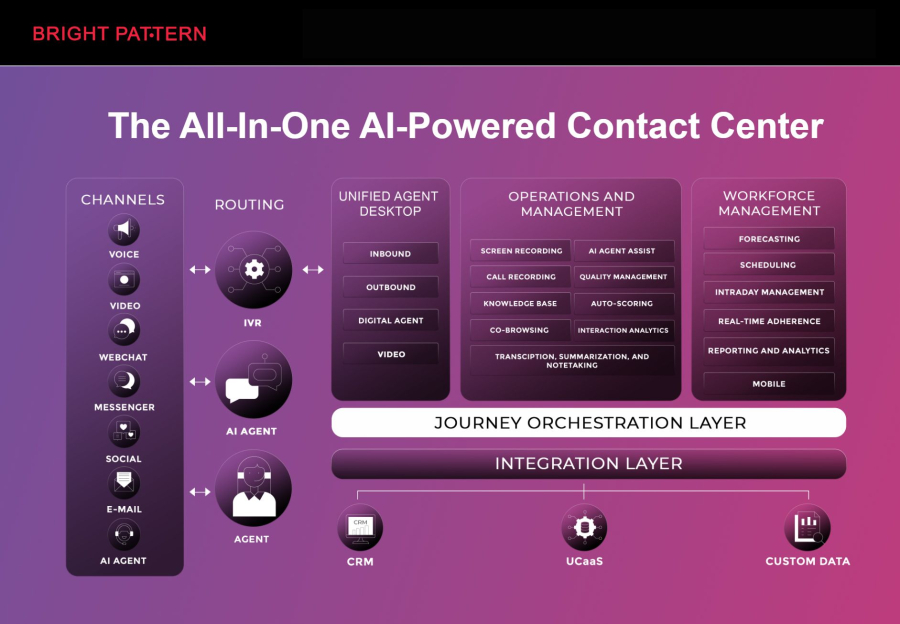
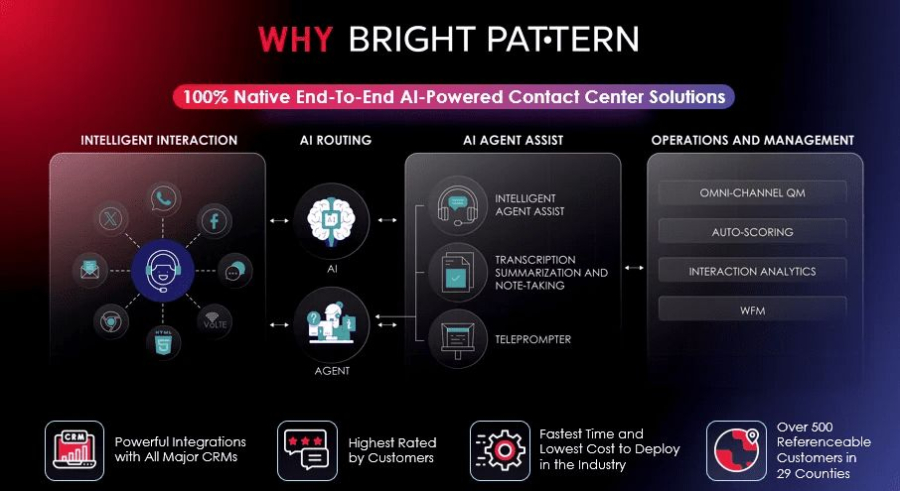
Bright Pattern is a leading provider of AI-driven contact center software, widely recognized for its agent assist AI capabilities. The platform integrates real-time assistance, predictive analytics, and omnichannel support to help agents deliver faster, smarter, and more personalized service.
Key features of Bright Pattern include:
- Real-time agent suggestions and next-best-action recommendations
- Omnichannel support including chat, email, SMS, voice, and social media
- Seamless CRM integration for a unified customer view
- AI-powered analytics for monitoring performance and improving CX
- Customizable dashboards for managers and agents
Businesses using Bright Pattern report significant improvements in response times, customer satisfaction, and agent productivity, making it an ideal choice for teams looking to scale efficiently while keeping costs under control.
2. Genesys
Genesys offers AI-enhanced contact center solutions with features like predictive routing, virtual assistants, and real-time agent coaching. It is suitable for enterprises seeking a robust platform that combines AI insights with cloud flexibility.
3. Five9
Five9 delivers a cloud contact center solution with intelligent automation and AI-powered agent assistance. Its platform focuses on improving agent efficiency, reducing handling time, and enhancing customer satisfaction.
4. NICE inContact
NICE inContact CXone integrates AI and analytics to optimize agent performance. Its agent assist AI features provide real-time guidance, knowledge management, and workflow automation to support complex interactions.
5. Talkdesk
Talkdesk uses AI to help agents handle queries faster and more accurately. The platform emphasizes automation, omnichannel support, and predictive insights to improve both agent productivity and customer experience.
6. Zendesk
Zendesk’s AI-powered features include automated suggestions, workflow recommendations, and conversational AI. It is particularly popular among mid-sized businesses looking for easy-to-deploy solutions with strong CRM integration.
7. Avaya
Avaya combines AI with contact center software to enhance agent performance. Its agent assist AI capabilities include real-time analytics, automated ticketing, and intelligent routing for faster resolution times.
8. Cisco Contact Center
Cisco provides AI-driven tools for agent assistance, including virtual agents, predictive analytics, and real-time performance insights. The platform is widely used in enterprises with complex multi-channel support needs.
9. 8x8 Contact Center
8x8 offers a cloud contact center solution that leverages AI for real-time guidance, performance monitoring, and customer journey analytics. It helps teams streamline operations and improve agent decision-making.
10. RingCentral
RingCentral’s contact center platform uses AI to provide agents with actionable insights, knowledge-based recommendations, and predictive analytics. It is known for ease of integration and supporting remote or hybrid agent teams.
What Is Agent Assist AI?
Agent assist AIis a set of artificial intelligence tools that help customer service agents during live interactions. It operates behind the scenes to understand conversations and surface the right information or actions at the right moment.
Typical capabilities include:
- Real-time guidancebased on what the customer is saying or typing.
- Suggested responsesthat agents can personalize and send quickly.
- Knowledge surfacingfrom FAQs, help centers, and documentation.
- Automated after-call worksuch as summaries, tagging, and disposition codes.
- Workflow recommendationsfor refunds, escalations, or troubleshooting steps.
Instead of having agents search through multiple systems, memorize complex policies, or manually write lengthy notes, agent assist AI does the heavy lifting so they can focus on the customer.
How Agent Assist AI Works (In Plain Language)
While implementations differ, most agent assist solutions follow a similar pattern:
- Listen and understand
The AI captures voice or chat conversations and uses natural language processing to identify the customer’s intent, sentiment, and key details. - Match to knowledge and workflows
It compares the conversation to existing knowledge bases, policies, and past interactions to find relevant answers or steps. - Recommend in real time
It surfaces suggestions directly in the agent’s console: possible replies, troubleshooting flows, or knowledge articles. - Automate follow-up tasks
When the conversation ends, the AI helps complete wrap-up tasks such as summaries, tags, and forms. - Learn and improve
Over time, it learns from agent choices, outcomes, and feedback to refine future recommendations.
The result is a support experience that feels smoother and more intelligent, both for your agents and your customers.
Key Benefits of Agent Assist AI
1. Faster Handle Times Without Rushing Customers
One of the biggest advantages of agent assist AI isspeed. When answers and workflows appear automatically, agents spend less time searching and more time solving.
This typically leads to:
- Shorter average handle times.
- Reduced need for holds while agents ask supervisors or consult manuals.
- More efficient, confident conversations.
Customers feel the difference as shorter waits, fewer transfers, and quicker resolutions.
2. Higher First Contact Resolution
Agent assist AI can dramatically boostfirst contact resolutionby making sure agents have the full context and best answer in front of them during that very first interaction.
For example, the AI can:
- Highlight relevant account details and recent interactions.
- Recommend the correct policy or flow for complex requests.
- Flag when a case is better suited for a specific specialized team.
When agents have this guidance at their fingertips, they can resolve more issues on the spot instead of calling back, escalating, or asking the customer to follow up.
3. Stronger Agent Confidence and Lower Burnout
Modern contact center roles are mentally demanding. Agents must juggle product knowledge, emotional intelligence, and multiple tools at once. Agent assist AI acts like a real-time coach, reducing cognitive load.
This leads to:
- Faster onboardingfor new hires, who do not need to memorize everything on day one.
- Greater confidencewhen dealing with unfamiliar or complex queries.
- Less stress and burnoutbecause the system absorbs part of the mental workload.
When agents feel supported instead of overwhelmed, they deliver friendlier, more focused service.
4. Consistent, Compliant Responses
In regulated or policy-heavy environments, even experienced agents can make mistakes. Agent assist AI promotesconsistencyandcomplianceby steering agents toward approved information and workflows.
With real-time guidance, you can:
- Reduce the risk of sharing outdated or incorrect information.
- Encourage adherence to scripts or required disclosures.
- Standardize handling of refunds, exceptions, or sensitive topics.
This reduces risk while keeping interactions natural and human, since agents always have the final say.
5. Richer Insights Into Customer Needs
Because agent assist AI is constantly analyzing conversations, it becomes a powerful source ofcustomer insight.
Over time, you can identify:
- Common reasons for contact and recurring pain points.
- Emerging issues with products, services, or policies.
- Topics that consistently require supervisor support.
These insights can guide improvements to self-service, product design, and training, creating a virtuous cycle of better experiences and lower contact volumes.
Top Use Cases for Agent Assist AI
Agent assist AI can support a wide variety of customer-facing teams. Below are some of the most common and high-value use cases.
Customer Support and Technical Help Desks
- Surfacing troubleshooting flows as soon as a problem is described.
- Recommending knowledge base articles based on chat messages or call transcripts.
- Summarizing technical conversations for smooth escalations.
Sales and Renewals Teams
- Suggesting qualifying questions and talk tracks during discovery calls.
- Highlighting upsell or cross-sell opportunities based on customer context.
- Automatically capturing notes and next steps after each call.
Billing, Claims, and Back-Office Operations
- Guiding agents through complex policy or eligibility checks.
- Ensuring required fields and documentation steps are not missed.
- Recommending the correct codes or dispositions.
Onboarding and Training Programs
- Supporting new agents with real-time prompts, instead of long manuals.
- Identifying knowledge gaps based on where agents need the most help.
- Providing supervisors with targeted coaching opportunities.
Core Features to Look For in an Agent Assist AI Solution
When evaluating agent assist AI, it helps to have a clear feature checklist. Not every organization needs every capability, but the following pillars are especially valuable.
1. Real-Time Understanding of Conversations
- Accurate recognition of customer intent and key entities like dates, order numbers, and product names.
- Support for your primary languages and communication channels (voice, chat, email, messaging).
- Ability to track sentiment and urgency as the interaction evolves.
2. Intelligent Suggestions and Knowledge Surfacing
- Suggested replies that agents can edit and send quickly.
- Smart ranking of knowledge articles so the most relevant appears first.
- Automatic linking to documentation or internal procedures.
3. Automated After-Call Work
- Conversation summaries that capture the issue, actions taken, and outcome.
- Recommended tags, categories, or dispositions.
- Pre-filled case notes that agents can review and confirm.
4. Integrations With Existing Tools
- Smooth integration with your CRM or ticketing system.
- Connection to your knowledge base and internal wikis.
- Compatibility with your telephony or contact center platform.
5. Security, Privacy, and Governance
- Robust data protection and access controls.
- Options to redact or mask sensitive information in transcripts.
- Clear governance for how training data is stored and used.
Implementing Agent Assist AI Successfully
Rolling out agent assist AI is not just a technology project. It is a people and process transformation. Here are practical steps that help organizations launch successfully and realize lasting value.
Step 1: Define Clear Objectives
Start by choosing a focused set of goals. For example:
- Reduce average handle time in a specific queue.
- Improve first contact resolution for a particular type of request.
- Shorten ramp-up time for new agents.
Clear objectives help define which features to prioritize and how to measure success.
Step 2: Start With a High-Impact Pilot
Instead of trying to transform the entire contact center at once, pick a pilot group and a well-defined scope. Some common starting points are:
- One channel, such as chat or email.
- One product line or region.
- A specific type of interaction, such as password resets or order status.
This approach lets you gather feedback, refine configuration, and prove value quickly.
Step 3: Engage Agents Early and Often
Agent buy-in is critical. Position agent assist AI as aco-pilotrather than a monitoring tool.
Helpful practices include:
- Involving frontline agents in early testing and configuration.
- Explaining how the tool reduces repetitive tasks and supports them.
- Creating easy paths for agents to give feedback on suggestions.
When agents feel heard and empowered, adoption accelerates and the AI improves faster.
Step 4: Tune Knowledge and Workflows
Agent assist AI is only as good as the knowledge and workflows it can access. Take time to:
- Update and clean your knowledge base before rollout.
- Standardize processes for common contact reasons.
- Retire outdated content that could confuse recommendations.
Well-structured content dramatically increases the quality and usefulness of AI suggestions.
Step 5: Measure, Learn, and Expand
Once your pilot is live, track performance against your goals and listen closely to agents and customers.
Adjustments might include:
- Refining which suggestions are shown and when.
- Updating knowledge articles based on agent behavior.
- Expanding to new teams, regions, or channels step by step.
A continuous improvement mindset keeps the system aligned with your evolving business needs.
Measuring the Impact of Agent Assist AI
To fully demonstrate the value of agent assist AI, define a clear measurement framework. Common metrics include:
Operational Metrics
- Average handle timefor assisted vs. non-assisted interactions.
- First contact resolution ratefor key issue types.
- After-call work timeper interaction.
- Transfer and escalation ratesto higher tiers.
Experience Metrics
- Customer satisfactionor feedback scores.
- Agent satisfactionand engagement.
- Quality assurance scoresand adherence to policies.
Business Outcomes
- Cost per contact across different channels.
- Retention, renewal, or upsell rates where relevant.
- Time to proficiency for new hires.
By tracking these metrics before and after implementation, you can clearly communicate the impact to stakeholders and guide ongoing investments.
Frequently Asked Questions About Agent Assist AI
Does Agent Assist AI Replace Human Agents?
No. Agent assist AI is designed toaugment, not replace, human agents. It handles repetitive information retrieval and documentation while humans handle empathy, judgment, and complex decisions. Organizations that deploy agent assist typically use it to raise quality, support growth, and reduce burnout rather than to eliminate roles.
Is It Difficult to Train and Maintain?
The effort required depends on your existing knowledge assets and processes. If you already maintain a structured knowledge base, implementation is typically smoother. The most successful teams treat agent assist AI as a living system: they review analytics, update content, and tune workflows regularly to keep suggestions relevant and effective.
Will Agents Trust and Use the Recommendations?
Agent adoption is highest when the system is accurate, fast, and clearly presented as optional support. Allow agents to accept, edit, or ignore suggestions, and gather feedback on what helps them most. Over time, as the AI improves, agents naturally rely on it as a trusted assistant.
Is Agent Assist AI Only for Large Contact Centers?
While large operations benefit significantly, smaller teams can also see strong returns. For lean support teams, agent assist AI acts as a force multiplier, enabling them to deliver enterprise-grade experiences without enterprise-scale headcount.
The Future of Customer Support With Agent Assist AI
Agent assist AI is rapidly evolving from a nice-to-have assistant into a core component of modern customer operations. As models become more capable and integrations deepen, organizations can expect:
- Even more accurate and context-aware recommendations.
- Tighter alignment between self-service, bots, and human-assisted support.
- Richer analytics that inform product, policy, and process decisions.
Ultimately, the winning organizations will not be those that replace people with machines, but those thatpair human talent with intelligent assistanceto deliver fast, empathetic, and consistently excellent service.
By investing in agent assist AI today, you set your team up for a future where every interaction is smarter, every agent is more empowered, and every customer feels genuinely supported.
